Showing posts with label New Technology. Show all posts

Thursday, March 5, 2015

Morpheus
The new version of the Morpheus looks similar to the original, but has better components


Sony has revealed an upgraded version of its virtual reality helmet, which it says it plans to put on sale in 2016.
The new edition of Project Morpheus now features an OLED display, rather than an LCD one, letting it show more vibrant colours. That brings it in line with Facebook's rival Oculus Rift.
It is also capable of showing graphics at 120 frames per second (fps).
That beats the figure given by HTC for its recently unveiled Vive virtual reality (VR) headset.
The frame rate is important as the higher the number, the smoother moving objects appear. It also reduces the risk of nausea.
HTC said on Sunday that its helmet provided a refresh rate of 90fps.
Oculus has not confirmed its specifications, but recent demonstrations of the recent Crescent Bay version of its kit have also been reported to run at 90fps.
Sony virtual reality game
Sony showed off graphics from a shooter developed by its London-based studio
Sony's announcement is a surprise, because until now, the PlayStation console - which Morpheus depends on to play games - had not been thought to be able to render games at this rate.
However, speaking at the Game Developers Conference in San Francisco, PlayStation executive Shuhei Yoshida revealed that a software update would allow the machine to create an "in-between frame" to double its current maximum of 60fps.
"Higher frame rates are definitely important because they are going to translate into higher responsiveness of the gaming environment," explained Brian Blau, an analyst at the Gartner tech consultancy who previously worked in the virtual reality industry.
Sony DualShock controller
Morpheus can be used with the PlayStations standard DualShock 4 controller
"That's going to mean people who are wearing the device aren't going to feel as sick. 120fps approaches the range where you don't notice the changes in the graphics - they will be smooth and fluid."

Morpheus
Morpheus includes built-in accelerometer and gyroscope sensors to detect movement
Other details revealed at GDC include:


  • Morpheus now has a 0.018 second latency rate - the gap in time between the user moving their head and the headset responding. It was previously 0.04 seconds. Mr Yoshida suggested this meant the lag had now become imperceptible
  • The headset's screen is now 5.7in (14.5cm) - up from 5in before - and provides a 100-degree field of view, which should cover most of what the user sees
  • The number of LEDs used to track head movement has been increased from six to nine. Sony says this will improve the stability of the 360-degree tracking provided by its separate PS4 camera
  • A quick-release button has been added to make it easier for users to remove the headset
The screen resolution remains at 1080p high definition, providing 960 pixels by 1080 pixels per eye.
Mr Yoshida said the current version was "near final", suggesting there were further improvements to be made before it goes on sale, which is scheduled to happen within the first six months of 2016.
He added that more details would be unveiled at the E3 video games expo in June.
The release date is later than that of HTC's Vive headset - a collaboration with video games publisher Valve - that is set to launch before the end of this year.
HTC's kit is expected to be designed for games sold via Steam's PC-focused Steam online marketplace, meaning it may not directly compete with Sony's machine. PCs can generate higher quality moving images than the PS4 if fitted with special graphics cards.
Lighthouse tracking tech
Valve also released more details about how its VR system would work.
It said a tracking-system called Lighthouse would let users explore a virtual space and the objects within it from different angles by moving about in real life.
"In order to have a high quality VR experience, you need high-resolution, high-speed tracking," said Valve's Alan Yates in a statement released by the firm.
"Lighthouse gives us the ability to do this for an arbitrary number of targets at a low enough bill-of-materials cost that it can be incorporated into TVs, monitors, headsets, input devices, or mobile devices."
The firm said it would allow manufacturers to build Lighthouse into their products without charging them a fee.

The original version, which is 10 years old, was used to make games including Half-life 2, Portal and Titanfall.
It also announced the Source 2 games engine - software used to create video games with 3D graphics - which it is making available to third-party developers.
Valve may provide more details about its VR platform later this week when selected GDC attendees will be among the first to try out the HTC Vive.
Titanfall
Titanfall was one of the most recent games to have been run on Valve's Source games engine


'Seminal year'
Oculus has yet to set a release date for its PC-connected virtual reality helmet.
However, Samsung already sells Oculus-branded VR kit that uses its smartphones as screens.
"I think 2015 and 2016 are going to be seminal years for VR," said Mr Blau.
"There's a lot of products coming to market, which is going to mean consumers get to experience it in a way they haven't been able to do before: at home and in high quality.
Morpheus
Morpheus will require the user to have access to a PS4 camera to track its movements
"Here at GDC, there are a lot of developers who are interested in VR.
"But the big issue is, will the helmets be affordable or expensive. The early adopters will probably pick one up and pay whatever price is asked, but a higher price will limit sales for mainstream gamers."

 Reference: http://www.bbc.com/news/technology-31723030

Sony's Morpheus virtual reality helmet set for 2016 launch


3D printing 

What 3D printing is

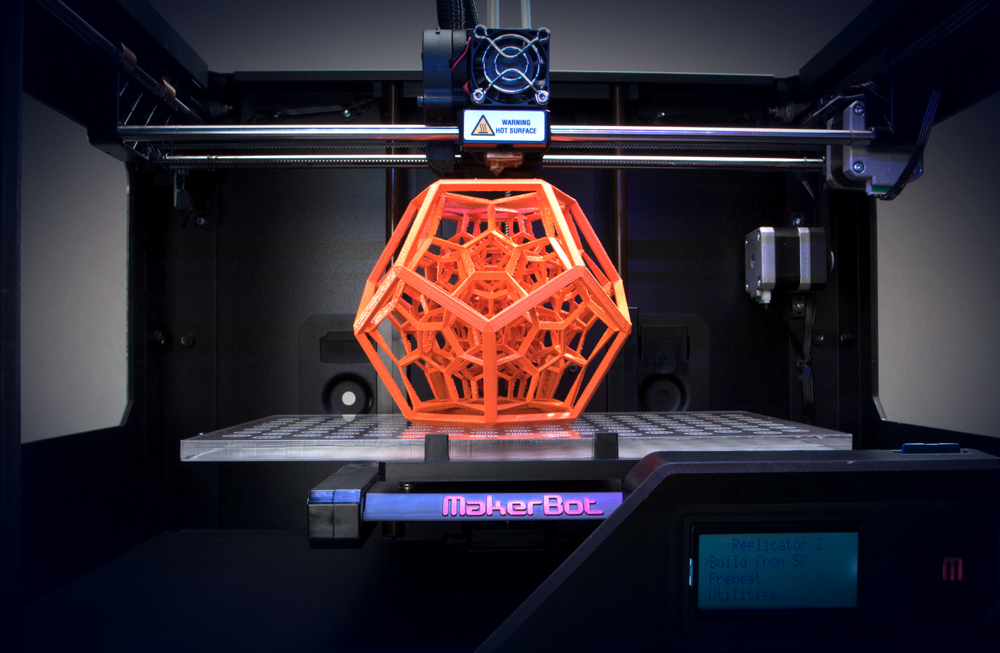
3D printing or additive manufacturing is a process of making three dimensional solid objects from a digital file. The creation of a 3D printed object is achieved using additive processes. In an additive process an object is created by laying down successive layers of material until the entire object is created. Each of these layers can be seen as a thinly sliced horizontal cross-section of the eventual object.

How does 3D Printing work?

It all starts with making a virtual design of the object you want to create. This virtual design is made in a CAD (Computer Aided Design) file using a 3D modeling program (for the creation of a totally new object) ór with the use of a 3D scanner (to copy an existing object). This scanner makes a 3D digital copy of an object and puts it into a 3D modeling program.
To prepare the digital file created in a 3D modeling program for printing, the software slices the final model into hundreds or thousands of horizontal layers. When this prepared file is uploaded in the 3D printer, the printer creates the object layer by layer. The 3D printer reads every slice (or 2D image) and proceeds to create the object blending each layer together with no sign of the layering visible, resulting in one three dimensional object.

Methods and technologies of 3D Printing

Not all 3D printers use the same technology to realize their objects. There are several ways to do it and all those available as of 2012 were additive, differing mainly in the way layers are build to create the final object. Some methods use melting or softening material to produce the layers. Selective laser sintering (SLS) and fused deposition modeling (FDM) are the most common technologies using this way of printing. Another method of printing is to lay liquid materials that are cured with different technologies. The most common technology using this method is called stereolithography (SLA).
Selective laser sintering (SLS)
This technology uses a high power laser to fuse small particles of plastic, metal, ceramic or glass powders into a mass that has the desired three dimensional shape. The laser selectively fuses the powdered material by scanning the cross-sections (or layers) generated by the 3D modeling program on the surface of a powder bed. After each cross-section is scanned, the powder bed is lowered by one layer thickness. Then a new layer of material is applied on top and the process is repeated until the object is completed.
All untouched powder remains as it is and becomes a support structure for the object. Therefore there is no need for any support structure which is an advantage over SLS and SLA. All unused powder can be used for the next printing. SLS was developed and patented by Dr. Carl Deckard at the University of Texas in the mid-
1980s, under sponsorship of DARPA.

3D printing

Friday, February 20, 2015

HTTP/2

The move to HTTP/2 is promised to make the web quicker and safer

A new web protocol that promises to speed up internet browsing has been approved.
The changeover to HTTP/2, when it happens, will be the first major update to the standard in 15 years.
The Internet Engineering Steering Group (IESG) has accepted the protocol, one of its senior members wrote in a blogpost on Wednesday.
The standard will now go on to be edited before being applied, Mark Nottingham added.
Its developers believe the new standard will represent a big step forward because it will make pages load quicker and improve encryption.
Compatible
In another blogpost, written in January last year, Mr Nottingham - who chairs the Internet Engineering Task Force's (IETF) HTTP working group - wrote about the proposed benefits of HTTP/2.
Instead of trying to reinvent the protocol, he said that the group was seeking to make the new one compatible with the old.
"Making HTTP/2 succeed means that it has to work with the existing web. So this effort is about getting the HTTP we know on the wire in a better way," he wrote then.
Tim Berners-Lee
British computer scientist Sir Tim Berners-Lee invented the World Wide Web in 1989
Hypertext transfer protocol - HTTP - is the means by which browsers communicate with servers to render pages.
The new version, Mr Nottingham wrote, would make it easier to use the web's encryption technologies, encouraging more websites to do so.
'Not pixie dust'
But he added that HTTP/2 was not "magic Web performance pixie dust".
Instead of improving webpage loading times by half, it was "more accurate to view the new protocol as removing some key impediments to performance", he wrote.
"Once browsers and servers learn how and when to take advantage of that, performance should start incrementally improving."
The protocol is based on a Google technology called SPDY, which has been used in recent years. Google will switch to HTTP/2 in its Chrome browser.

Reference : http://www.bbc.com/news/technology-31520407

New HTTP/2 protocol to speed up the web is approved

 
IT Society ©